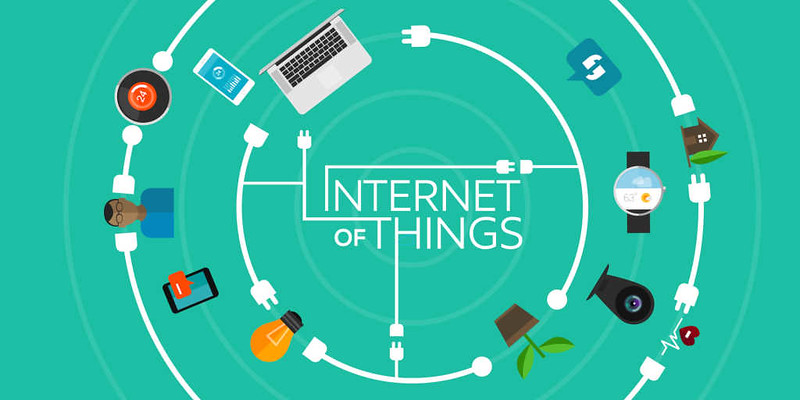
Better 5G positioning: This item “focuses on industrial IoT applications where precise location information is required,” wrote the analysts with Signals Research Group in their comprehensive look at the 3GPP’s latest efforts. “In addition to more enabling more precise location information (for IIoT use cases), this item will include a latency component, meaning there is an additional objective that the location information is provided in a timely manner.” The Center for Advanced Technology in Telecommunications and Distributed Information Systems (CATT), which is part of NYU Wireless, is taking the lead in this work item.
Read the full article on lightreading.com
Category: news
In Memoriam: Richard Van Slyke
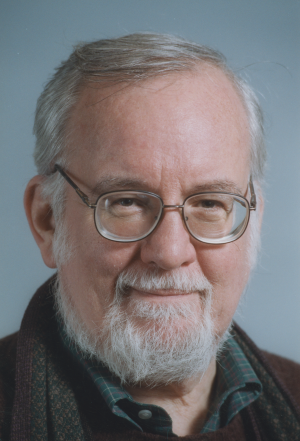
We mourn the passing on August 30 of Professor Richard Van Slyke, who played an enormous role in positioning NYU Tandon at the forefront of telecommunications research.
 Richard Van Slyke was one of the founders of the Network Analysis Corporation (NAC), a telecommunications consulting firm, serving as a principal there until 1980 when NAC — at that point 100 employees strong — was sold to Continental Telephone. He then returned to academia, spending three years as a Professor of Electrical Engineering and Computer Science at the Stevens Institute of Technology, in New Jersey.
In 1983 the governor of New York designated NYU Tandon (then the Polytechnic Institute of New York) as a New York State Center for Advanced Technology in Telecommunications (CATT), and Professor Van Slyke agreed to cross the river to Brooklyn to serve as its first director and to teach. He later wrote, “The main objective [of CATT] was the idea of being a catalyst for joint activities in the newer technologies of communication and the companies that sold the technology and/or used it. … We had [an educational] forum, which had active participation by industrial people. The major thing I liked about Poly was this dual commitment to serious research and also to teaching.”
The forums ran for more than a decade, and during that period he also spearheaded two industry-oriented master’s degree programs, in Telecommunications Management and Information Systems Engineering.
During the 1995-96 academic year he took the helm of what was then known as the Department of Computer and Information Science, and at the time of his retirement, in 2005, after a tenure of more than two decades, he was named Professor of Computer Science Emeritus.
Despite his undisputed expertise in such areas as the design and analysis of algorithms, parallel computation, and database systems; his stint as vice-chair of the IEEE’s Committee on Computer and Information Policy; his time on the Telecommunications Educational Advisory Council of the National Engineering Consortium; and his dozens of publications, Professor Van Slyke is perhaps best known for his warmth and humor. “I’ll always remember his laughter, which was unique to him and which had the ability to make everyone feel welcome and comfortable,” Professor of Computer Science and Engineering Haldun Hadimioglu said. “You always felt that you were with a good friend when you were with him.”
Professor Emeritus of Computer Science and Engineering Henry Bertoni also mentioned his colleague’s laughter when he penned the following remembrance:
“Richard was a soft-spoken man with a ready laugh; he was at ease with new people and ready to consider new ideas. While my earlier research was outside of the area of telecommunication networks, in the mid-1980s I began to work on problems dealing with radio coverage for the then-new cellular telephone systems. At that time, only a limited number of people used cell phones. However, Richard saw the potential for growth in the service when others did not. In order for me to attend meetings in Washington, D.C. of an IEEE technical committee dealing with issues effecting cell phone service, Richard offered me travel support from CATT. He further supported the resulting research activity with the nearly full-time use of a mini-computer (computers and cell phones have come a long way in a mere 35 years). The resulting work became part of industry standards on cellular coverage. It was with Richard’s foresight and encouragement that Poly started its wireless program, which eventually attracted outstanding new faculty and students and is now the world-famous NYU WIRELESS research center.”
Professor Van Slyke held a B.S. in Physics from Stanford (1959) and a Ph.D. in Engineering Science from the University of California, Berkeley (1965). He began his career as a faculty member at the University of California, remaining there until 1969.
Professor Van Slyke will be deeply missed by all who worked and studied (and laughed) with him. Our deepest condolences go to his wife, Irene, and the rest of his family.
Shivendra Panwar Presents at the 40th IEEE Sarnoff Symposium 2019
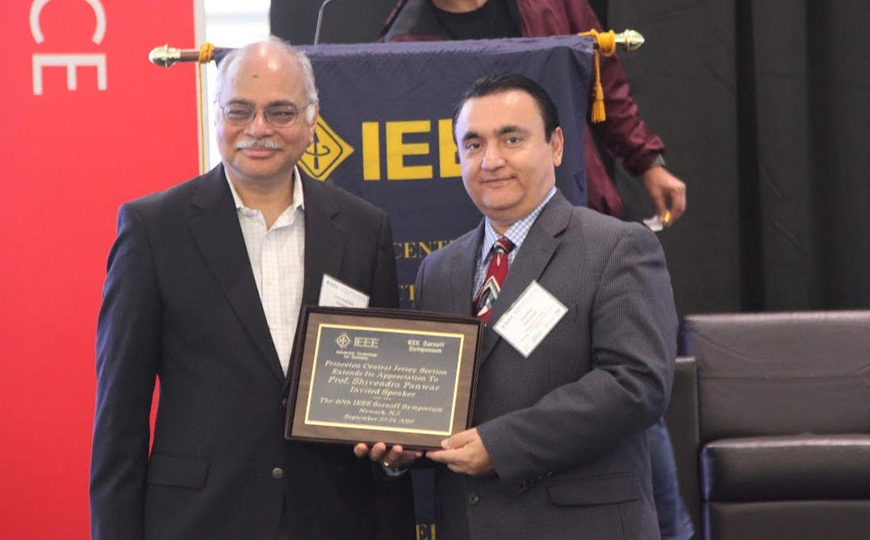
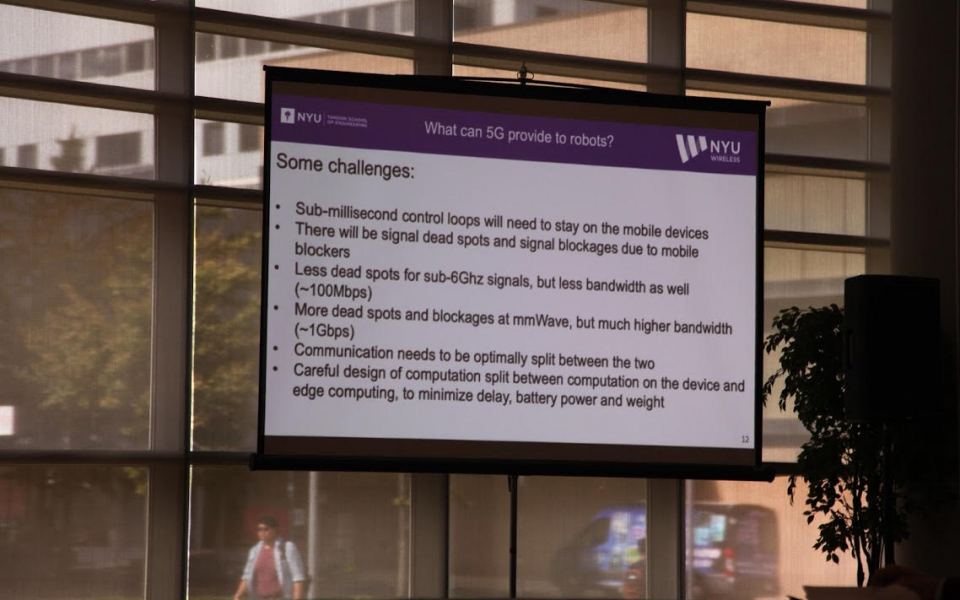
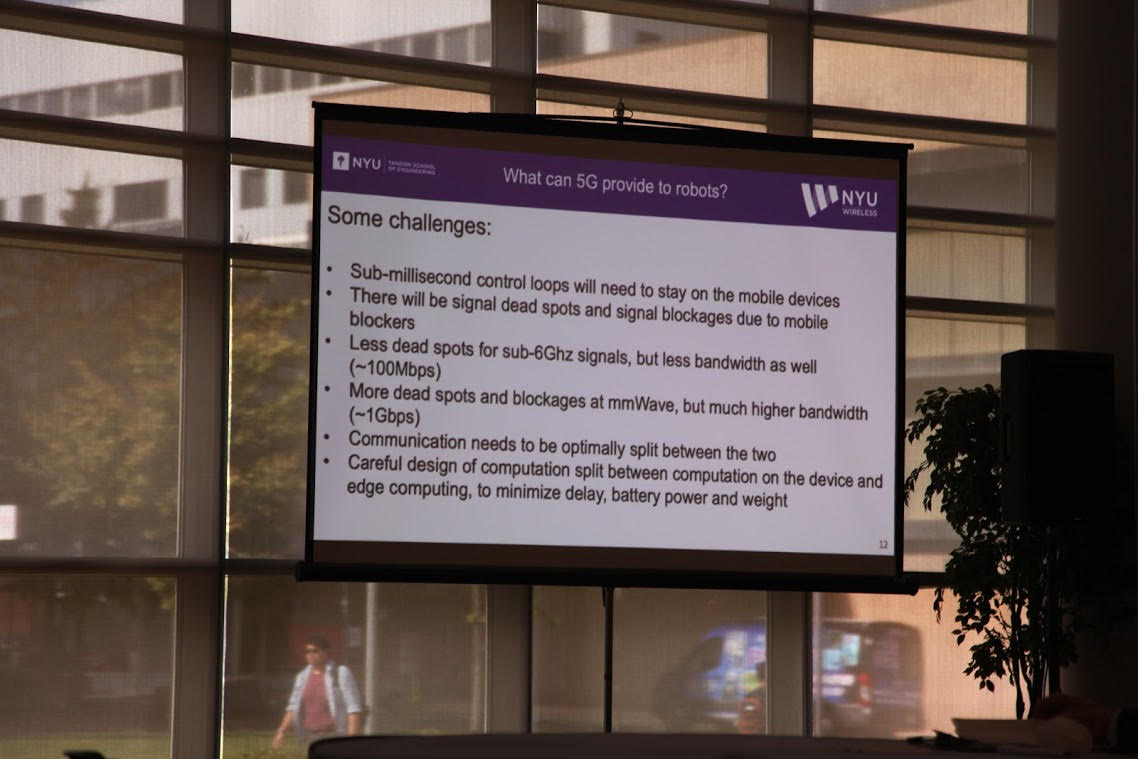
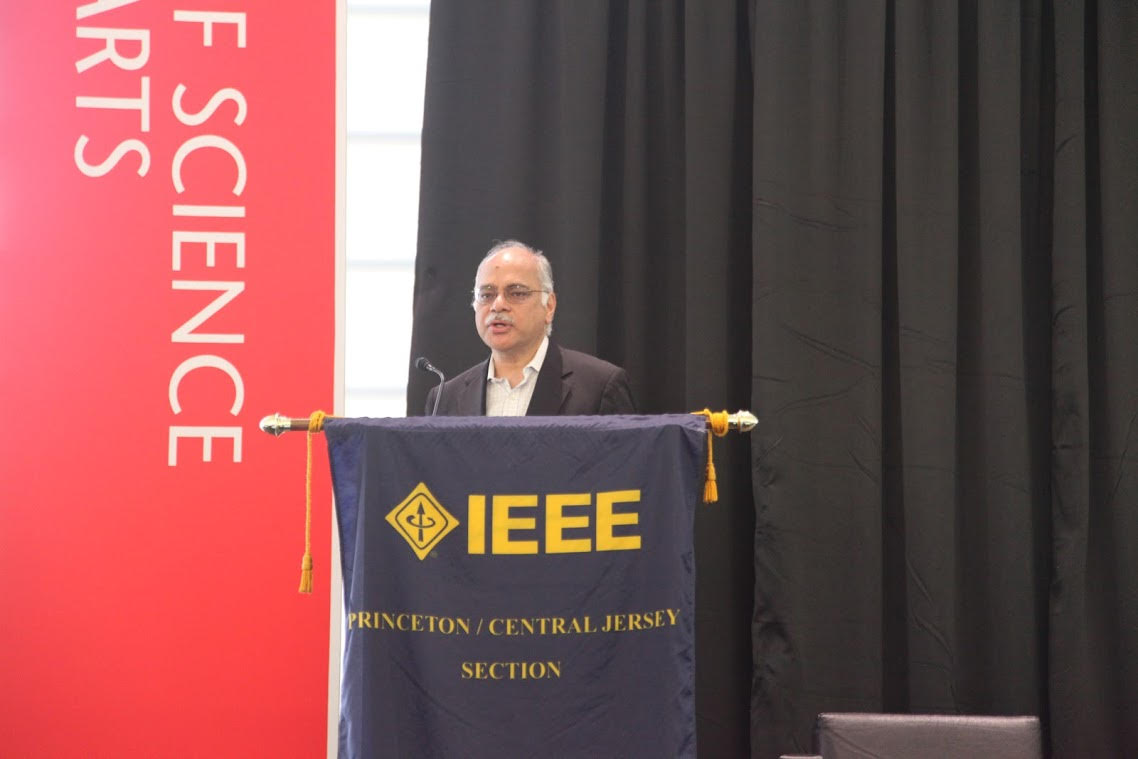
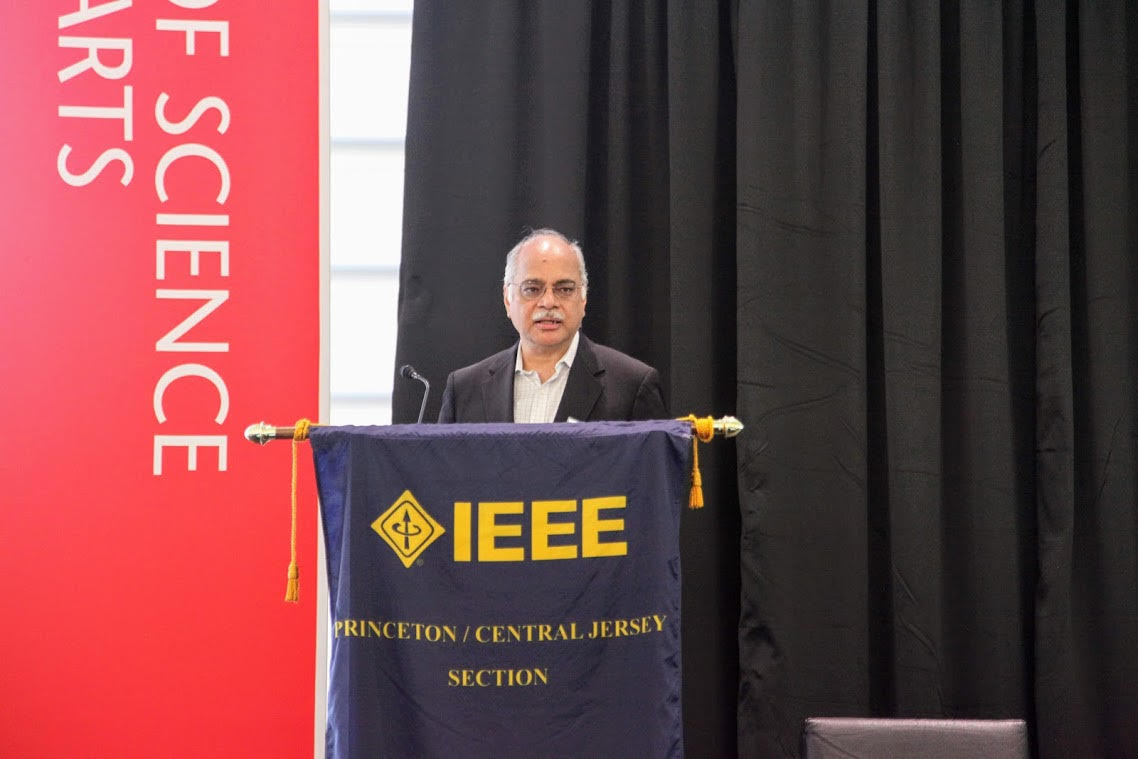
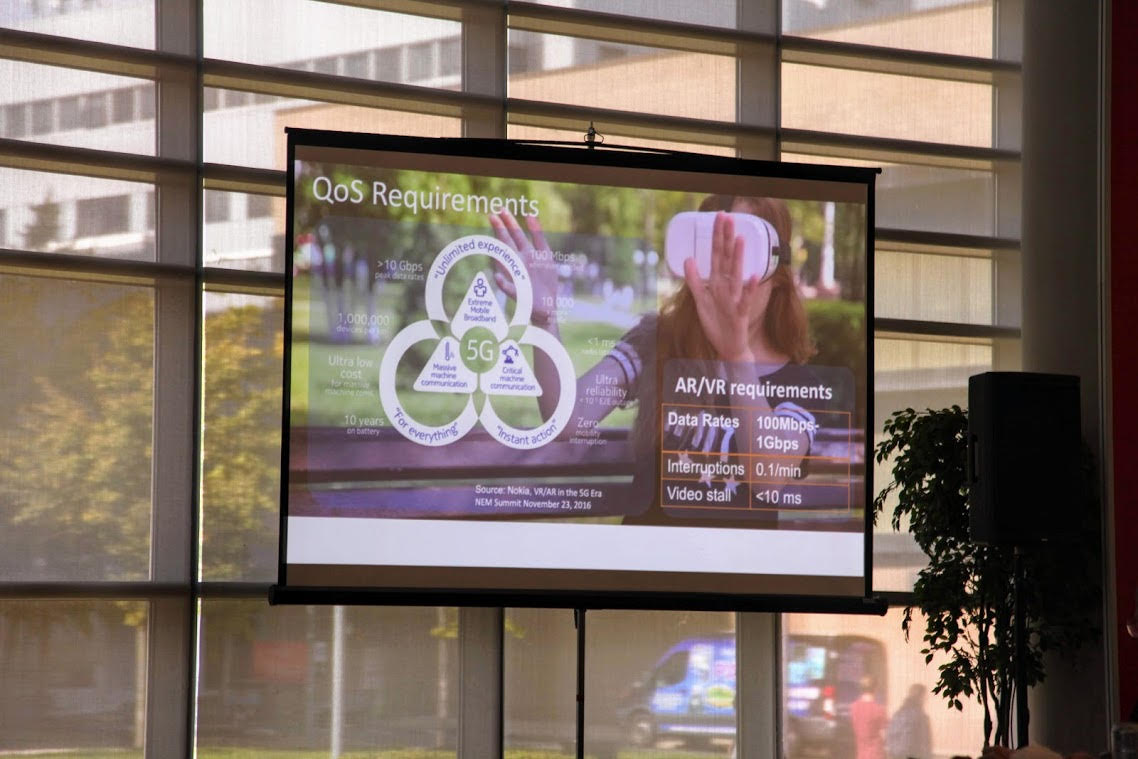
Shivendra Panwar, the director of CATT, gave a keynote presentation at the 40th IEEE Sarnoff Symposium 2019 on September 24, 2019. His presentation, “5G: Millimeter waves, millisecond delays?” provided an overview of 5G’s unique promise of ultra-reliable low latency communications while outlining some of the challenges 5G brings to the mobile landscape.
These challenges include:
- sub-millisecond control loops will need to stay on mobile devices
- signal dead spots and signal blockages due to mobile blockers
- less dead spots for sub-6GHz signals, but less bandwidth as well (~100Mbps)
Prof. Panwar’s presentation was based off of his 2018 paper of the same name. Millimeter Waves, Millisecond Delays is available on the ACM Digital Library.
Abstract from Millimeter Waves, Millisecond Delays
Two simultaneous revolutionary changes are occurring in networking: the advent of mmWave networks and the advent of applications that require end-to-end delays of the order of a few milliseconds. mmWave is the first physical layer technology that promises huge wireless bandwidth, but with very poor reliability as a result of its vulnerability to blockage (optical fiber offers high reliability and high bandwidth; sub-6Ghz microwave networks offer lower bandwidth but graceful bandwidth degradation that can be mitigated). The emergence of the need for ultra-low delays for haptic communications and control loops in self-driving cars and other sensor-based applications, has radically changed the requirements for layers above the physical layer. These two changes transform standard networking problems and will lead to a new wave of research. Examples will be used to illustrate this paradigm shift.

The Arrival of 5G Will Revolutionize Game Streaming
“In five to 10 years, a game-streaming company will be as prevalent as Netflix,” Shivendra Panwar, a professor of electrical and computer engineering and director of CATT.
5G is going to make your cellphone much faster, and that’s going to change gaming dramatically. 4G, adopted 10 years ago, is shorthand for “fourth generation” mobile technology. It exponentially increased the amount of data sent to your phone and made it possible to stream high-quality video. 4G tech put a DVD player in your pocket; 5G is going to put a PlayStation there too.
“In five to 10 years, a game-streaming company will be as prevalent as Netflix,” Shivendra Panwar, a professor of electrical and computer engineering and director of the New York State Center for Advanced Technology in Telecommunications at New York University, tells Newsweek. Total game sales around the world were estimated to have been $138 billion in 2018.
Panwar says companies like Netflix took off because of wireless consumption of their videos, first via home Wi-Fi and then on phones following the arrival of 4G. But the change didn’t happen fast. “In the early years, video-streaming quality wasn’t great, and it was not available everywhere,” he says.
Jack Keil Wolf Lecture Series
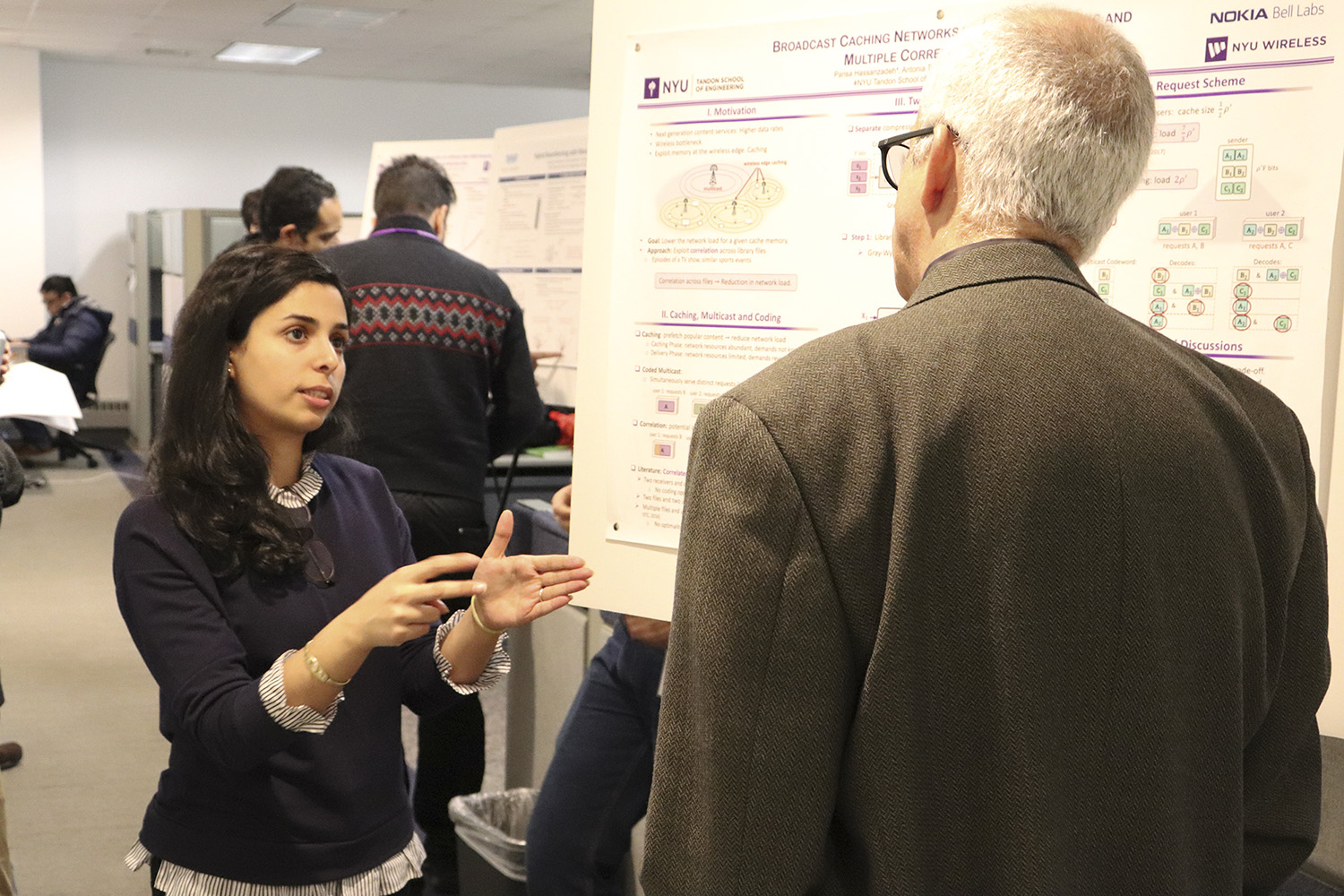
Speaker: Muriel Medard, MIT
Time: 2:00 pm – 3:00 pm Jan 24, 2019
Location: 2MTC Room 9.009, Brooklyn, NY
Abstract: We introduce a new algorithm for Maximum Likelihood (ML) decoding based on guessing noise. The algorithm is based on the principle that the receiver rank orders noise sequences from most likely to least likely. Subtracting noise from the received signal in that order, the first instance that results in an element of the code-book is the ML decoding. For common additive noise channels, we establish that the algorithm is capacity achieving for uniformly selected code-books, providing an intuitive alternate approach to the channel coding theorem. When the code-book rate is less than capacity, we identify exact asymptotic error exponents as the block-length becomes large. We illustrate the practical usefulness of our approach in terms of speeding up decoding for existing codes.
Joint work with Ken Duffy, Kishori Konwar, Jiange Li, Prakash Narayana Moorthy, Amit Solomon.
About the Speaker: Muriel Medard is the Cecil H. Green Professor in the Electrical Engineering and Computer Science (EECS) Department at MIT and leads the Network Coding and Reliable Communications Group at the Research Laboratory for Electronics at MIT. She has co-founded three companies to commercialize network coding, CodeOn, Steinwurf and Chocolate Cloud. She has served as editor for many publications of the Institute of Electrical and Electronics Engineers (IEEE), of which she was elected Fellow, and she has served as Editor in Chief of the IEEE Journal on Selected Areas in Communications. She was President of the IEEE Information Theory Society in 2012, and served on its board of governors for eleven years. She has served as technical program committee co-chair of many of the major conferences in information theory, communications and networking. She received the 2009 IEEE Communication Society and Information Theory Society Joint Paper Award, the 2009 William R. Bennett Prize in the Field of Communications Networking, the 2002 IEEE Leon K. Kirchmayer Prize Paper Award, the 2018 ACM SIGCOMM Test of Time Paper Award and several conference paper awards. She was co-winner of the MIT 2004 Harold E. Edgerton Faculty Achievement Award, received the 2013 EECS Graduate Student Association Mentor Award and served as Housemaster for seven years. In 2007 she was named a Gilbreth Lecturer by the U.S. National Academy of Engineering. She received the 2016 IEEE Vehicular Technology James Evans Avant Garde Award, the 2017 Aaron Wyner Distinguished Service Award from the IEEE Information Theory Society and the 2017 IEEE Communications Society Edwin Howard Armstrong Achievement Award.
Streaming Live This Fall: Terahertz–the Next Frontier for Communications and Electronics
- Microwave Journal
- August 28, 2018
- Source: http://www.microwavejournal.com/articles/30954-streaming-live-this-fall-terahertzthe-next-frontier-for-communications-and-electronics
The next frontier for ultra-fast computing and wireless communications–the terahertz electromagnetic spectrum–will be examined in a series of seminars by foremost scientists and engineers in the field. Organized by the NYU WIRELESS research center and NYU Tandon School of Engineering’s Electrical and Computer Engineering Department, the series at the school’s Brooklyn campus will be streamed for NYU WIRELESS industrial affiliate sponsors and the public and archived for later viewing.
Students Prototype The Future
If you’re looking for the next big idea in emerging media, such as virtual and augmented reality (VR/AR) and artificial intelligence (AI), there is no better place to look than universities like NYU. This reality is one that NYC Media Lab understands quite well. Tapping into New York’s student talent pool, the organization helps students develop prototypes that will disrupt and advance sectors such as media, technology, healthcare, retail, advertising, and more.
This prototyping of the future was on full display at the recent Demo Day of the Verizon Connected Futures Prototyping & Talent Development Program. Sponsored by NYC Media Lab and Verizon, the Connected Futures program supported 12 student teams who created projects within the areas of AR design and marked tracking, social VR/AR, the intersections of AR and AI, and the next generation in wireless technology. Gaining expertise and insight from the team at Verizon Envrmnt, students from across New York universities, including NYU Tandon School of Engineering, The New School, and Columbia University, designed, iterated and built their ideas into prototypes over six weeks. The program also benefits from support from the Center for Advanced Technology in Telecommunications and Distributed Information Systems (CATT).
“Through our Verizon Connected Futures program, we have a dozen new ideas at various stages of realization,” Justin Hendrix, Executive Director of NYC Media Lab, shared at the Demo Day. “We’re experiencing what’s possible right now with new technology.” The 12 teams designed products and services that span various industries, including education, transportation, retail, music, psychology, and more.
Driven by their passion for innovation and using technology to serve society, three NYU Tandon student teams shared their prototypes to a rapt audience of industry experts at the Demo Day.
CitytravelAR
Baris Siniksaran and Subigya Basnet with their mobile app CitytravelAR
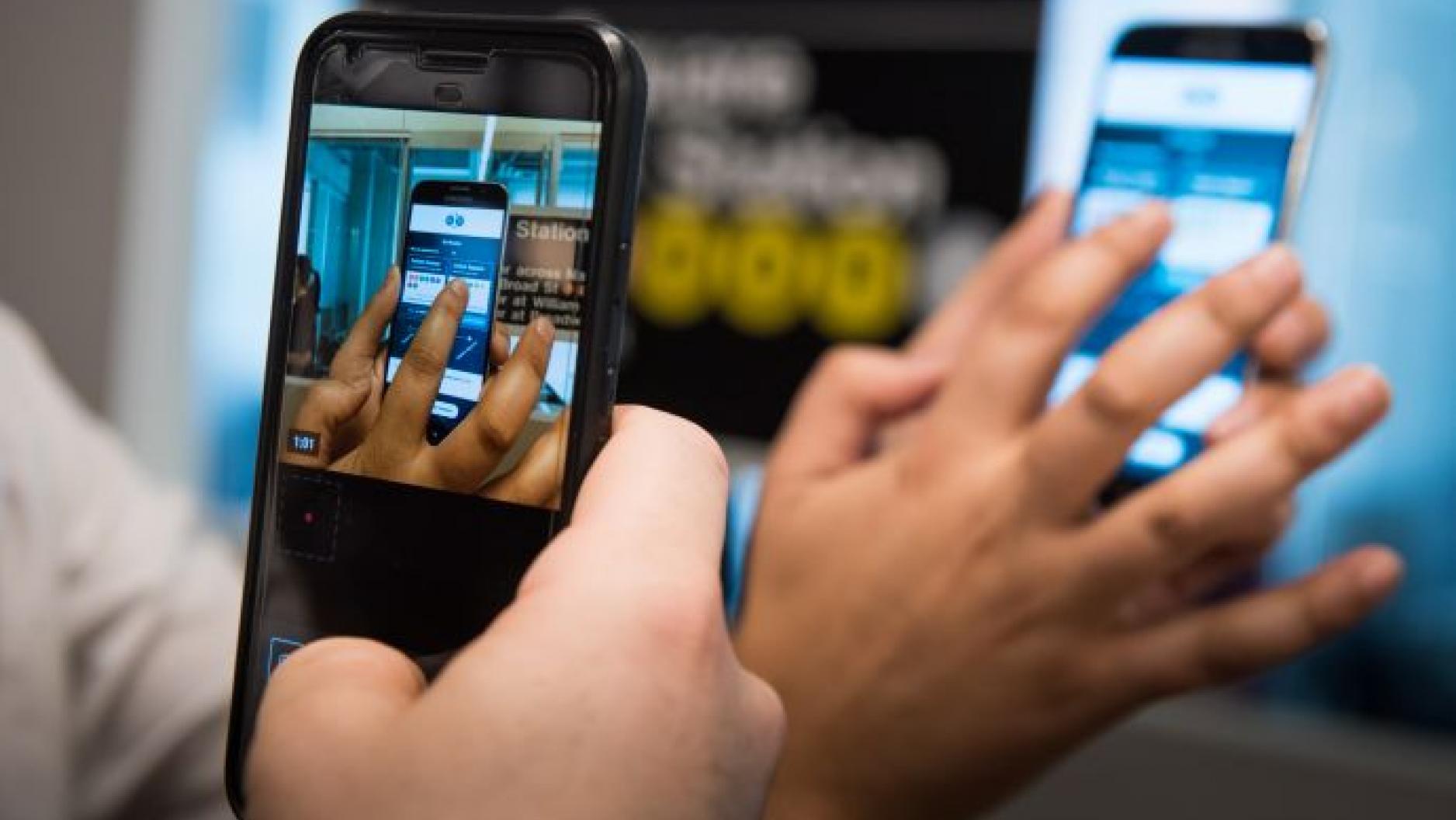
Navigating the New York City subway system can be difficult, so the team behind CitytravelAR created an augmented reality wayfinding platform that allows you to use your smartphone to easily get around the city. “Using subway signage as AR markers, users would be able to not only find out the best train route for their journey, but also learn about local communities in and around the station area,” Subigya Basnet said. Basnet alongside his teammates and fellow Integrated Digital Media graduate students Vhalerie Lee and Baris Siniksaran hope their application can function within building smart cities using AR technology to merge commuting and community. “For all of us, NYU Tandon gave us the platform to begin this dive into VR/AR production and development,” Basnet shared, as he, Lee, and Siniksaran have all created projects like the “Game of Thrones” AR narrative experience and WAVR. “The opportunity to experiment our ideas encouraged us to take up opportunities, like the Verizon Connected Futures Challenge.”
ARSL
Heng Li and Mingfei Huang demonstrate ARSL
Computer science students Zhongheng (Heng) Li, Jacky Chen, and Mingfei Huangdebuted their mobile app that provides real-time sign language interpretation to help people communicate with each other more easily. With computer vision, cloud computing, and AR, ARSL uses a smartphone’s camera to capture and translate sign languages into the other user’s native spoken language, and instantaneously records spoken language and translates into sign. “This accessible solution empowers people to get connected,” Li said, adding that his team has a shared passion for using emerging tech for social good. With the millions of people around the world who are deaf or hearing impaired, this app could help people book appointments, explain their symptoms to doctors, or ask for directions, all through a translator in the palm of their hands.
Vrbal
Olivia Cabello, far right, was part of the multi-school team Vrbal
Olivia Cabello, a graduate student in Integrated Digital Media, has vast experience in human-centered design, and brought her expertise to the interdisciplinary and multi-school team that developed Vrbal. The VR training experience allows people with social anxiety or communication disorders to practice for situations, such as public speaking, interviews, and more. Using smart and adaptable technology, such as IBM’s Watson, Vrbal helps users gain more confidence and comfort in particular situations through its personalized environments and its interactive AI assistant that guides them along. Cabello added her user experience background to design Vrbal’s interface.
Camila Ryder
Graduate School of Arts and Science
Master of Arts in English Literature, Class of 2018
CATT Professor Claudio Silva Receives Emmy Award for His MLB Visual Analytics Tool

There may not have been a red carpet involved, but Professor of Computer Science and Engineering Claudio Silva had cause for celebration when the National Academy of Television Arts & Sciences (NATAS) announced the winners of the 2018 Technology and Engineering Emmy Awards, which honor breakthroughs in technology that have a significant effect on television engineering.
Silva is the developer of a visual analytics tool now being used in Major League Baseball (MLB) stadiums across the country as part of the Emmy-winning Statcast, which combines the tool with a radar-based ball-tracking system and an optical player-tracking solution.
Silva’s tool — which he dubbed Baseball 4D when he presented it at the 2014 Institute of Electrical and Electronics Engineers Visualization Conference — provided the ability to analyze each and every play on the field for the first time in sports history, allowing fans and industry officials to answer previously unanswerable analytics questions like where players should be positioned to best catch a ball traveling at a particular velocity or which players were most likely to accurately anticipate a pitch’s trajectory.
Silva collaborated with MLB Advanced Media on the development of the system — which involves groups of high-performance cameras installed throughout the ballpark along with software that produces highly interactive visualizations of the game in unprecedented detail. MLB Advanced Media shares the Emmy, which will be presented on April 8th, 2018 at a ceremony in Las Vegas, with the company ChyronHego, which was responsible for Statcast’s optical player-tracking equipment, and TrackMan, the creators of its radar-based ball-tracking system.
The Emmy win was not the only time in recent weeks that Silva had made a splash in the media. In Rio to visit the Fundação Getúlio Vargas, a well-regarded institution of higher learning, he was interviewed about machine learning and data visualization by the Brazilian publication O Globo.
While the Emmy may recognize the significance of visual analytics in sports, his research into data visualization has far-reaching applications and potentials, from building software in smart cars to creating interactive urban design models.
A Robust Pipeline to STEM
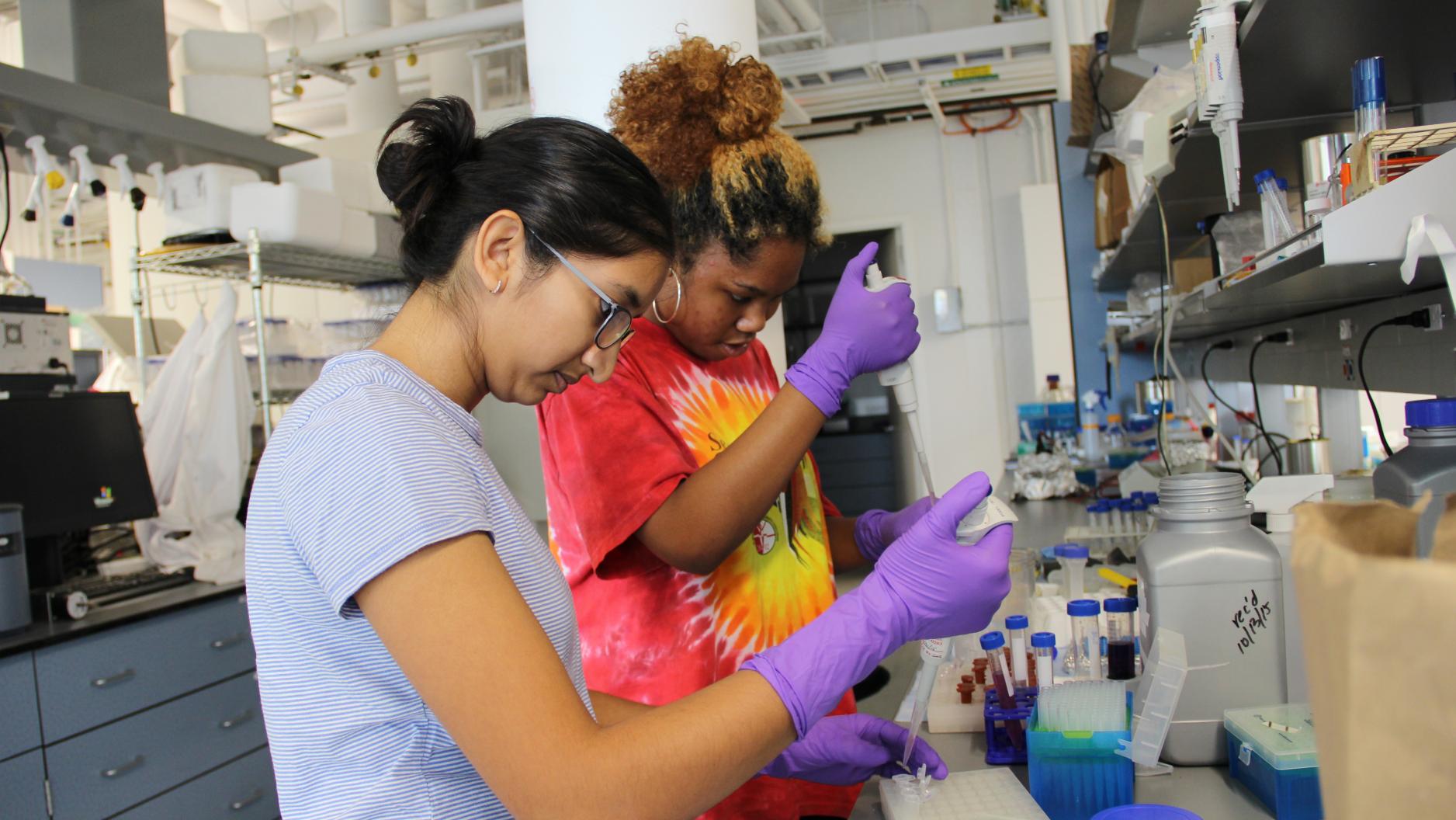
Jemima Costanza is now on a pre-med track. Maeve Farrell has set her sights on a career at a major research university. Edward Huang and Vicente Gomez are studying computer science as undergraduates. Amaya Munoz foresees a future as an electrical and computer engineer. Jamie Monroy views biotechnology as an exciting career path. The list could go on and on. After taking part in the Applied Research Innovations in Science and Engineering (ARISE) program as high school students, person after person begins to picture a career in the world of science, engineering, or technology one day.
Funded by a grant from the Pinkerton Foundation, ARISE was launched in 2013 by NYU’s Center for K12 STEM Education, with the aim of inviting rising juniors and seniors from New York City high schools into university labs to engage in high-level research. The seven-week program introduces them to the scientific method, data collection and analysis, lab safety, and ethics, and they are expected to make solid and useful contributions to their labs’ research objectives and daily operation. “We were individually mentored by graduate students and post-docs,” Gomez — who participated in ARISE in 2015 but whose connection to Tandon’s summer offerings stretches back even further, to when he participated in a program called Science of Smart Cities as a middle school student — recalls. “They did not sugarcoat the rigor a scientific career demands, and they didn’t take it easy on us simply because we were still in high school.”
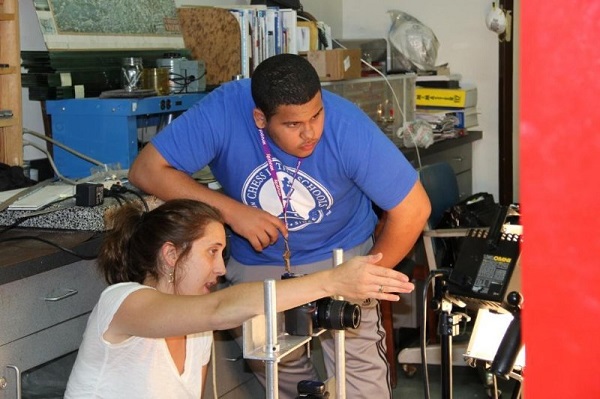
ARISE — which recruits many students from demographic groups generally underrepresented in STEM disciplines, including women, students of color and those from low-income backgrounds — hosted 48 participants this summer, embedding them in a wide variety of faculty labs (see below) and assigning them Tandon graduate and post-doctoral mentors.
The resulting projects, presented to the public at the end of the program, ranged from assessing DNA extraction methods from museum specimens, to building sensors to study noise pollution in the city, to testing the effects of temperature and orientation on 3D printed parts and more.
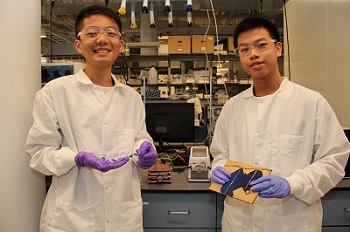
Jason Mei of Stuyvesant High School and Xue Ye Lin of Brooklyn Tech, for example, worked with Professor of Chemical and Biomolecular Engineering Miguel Modestino, who recently garnered a 2017 Global Change Award from the H&M Foundation for his development of a method of using solar energy and plant waste, rather than fossil fuel, to synthesize nylon. The pair — both of whom aspire to study chemical engineering once they are in college — fabricated custom solar arrays that may one day be employed to scale up Modestino’s process. “You might think that high school students would not be capable of making any meaningful or practical contributions in a university lab, but these two have proven you wrong,” Modestino says. “Their help was invaluable, and I’d be happy to have many more like them.”
Like Modestino, many of the professors who volunteered to host ARISE students were amply impressed. For proof, look no further than the figures compiled by Ben Esner, the head of the Center for K12 STEM Education.
“This year, an unprecedented 16 labs and faculty members have asked their ARISE students to continue working on their research during the school year, even though the program has officially ended for the summer,” he explains. “Out of 48 students, 26 will be staying on, furthering their own learning, contributing to their mentors’ research, and proving that programs like this are an invaluable way to get and keep young people interested in STEM.”
The Labs
At Tandon and NYU, researchers are happy to throw open their doors to the bright, motivated high school students of ARISE — a rarity when at many schools, even undergraduates might not get much of a chance to work with high-profile professors on important projects. This fall, ARISE participants from the summer will be returning to:
- Multifunctional Material Systems Lab
- Developmental Genomics Lab
- Chromosome Inheritance Lab
- Nanostructured Hybrid Materials
- Bio-interfacial Engineering and Diagnostics Group
- Dynamical Systems Lab
- Future Building Informatics and Visualization Lab (biLAB)
- Offensive Security, Incident Response and Internet Security Laboratory (OSIRIS)
- Soil Mechanics Lab
- Center for Advanced Technology in Telecommunications & Distributed Information Systems (CATT)
- Applied Micro-Bioengineering Lab
- Center for Urban Intelligent Transportation Systems
- Composite Materials and Mechanics Lab
- Biomolecular Engineering Lab
- Applied Dynamics & Optimization Lab
- Primate Hormones and Behavior Lab
NYU Wireless Researchers Build Emulator to Test 5G Networks
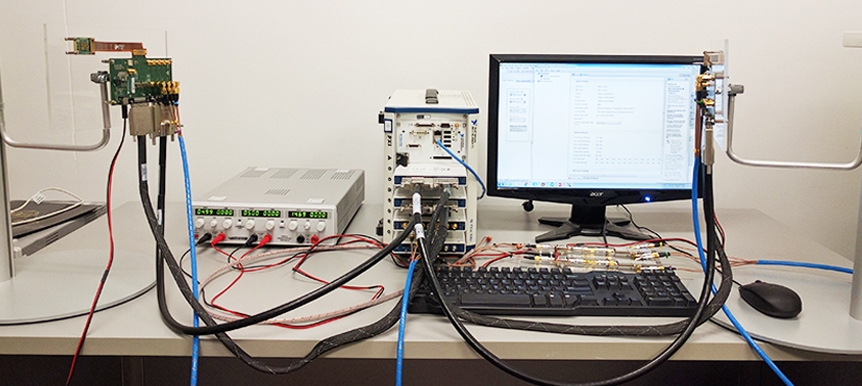
NYU Wireless teamed with the Center for Advanced Technology in Telecommunications (CATT) to build a wireless emulator for 5G systems. The emulator recreates both the wireless channel and the phased-array antennas. It can be used for transmitter and receiver devices so researchers can understand how 5G will perform in different environments and weather conditions.
According to a blog post from NYU Wireless, researchers used commercial off-the-shelf (COTS) hardware from National Instruments coupled with emulator software that is based upon reference designs available to the academic researchers. By using COTS, the researchers said they can lower the cost and complexity of the testing.