NYU Tandon, collaborating institutions and industry partners have been awarded nearly $10 million to develop next generation communications technology.
The project, dubbed SALSA (Spectrally Agile Large-Scale Arrays), is funded by the U.S. Department of Commerce’s National Telecommunications and Information Administration (NTIA) to advance U.S. leadership in open, secure communications infrastructure.
SALSA aims to create advanced wireless systems that operate in the “upper mid-band” spectrum — a region of frequencies relatively unused in cellular systems today that offers an optimal balance of coverage and data capacity. SALSA will develop an advanced radio frequency integrated circuit (RFIC) operating in these bands.
The RFIC will be designed for the Open Radio Access Network (O-RAN) framework to enable deployment in emerging commercial networks. The award comes through the NTIA’s Public Wireless Supply Chain Innovation Fund, established under the CHIPS and Science Act to promote O-RAN development and domestic manufacturing of telecommunications equipment, seen as crucial for economic competitiveness and national security.
“SALSA focuses on the upper mid-band — a sweet spot in wireless communications,” said Sundeep Rangan, the project’s lead investigator. Rangan is the Associate Director of the NYU WIRELESS research center and a professor of electrical and computer engineering at NYU Tandon. “The upper mid-band frequencies provide an optimal balance of bandwidth and coverage, making them ideal for future high-data-rate applications. The spectrally agile features of the SALSA RFIC will enable coordination between cellular operators, satellites, and federal systems, ensuring robust communications even in adverse conditions. The scale of this investment — which we believe represents one of the largest federal commitments to O-RAN — underscores this work’s importance.”
“This project represents a pivotal moment in wireless technology development that builds on NYU Tandon’s leadership in advancing cellular networks,” said Juan de Pablo, NYU’s Executive Vice President for Global Science and Technology and Executive Dean of NYU Tandon. “We’re creating new technologies that will democratize advanced wireless networks making them more open, efficient and secure- helping ensure that the next generation of wireless innovation serves the broader public good while strengthening America’s technological leadership.”
The SALSA project is structured around four major tasks: developing specialized wireless chips, building modular radio platforms, integrating with open network standards, and analyzing system performance.
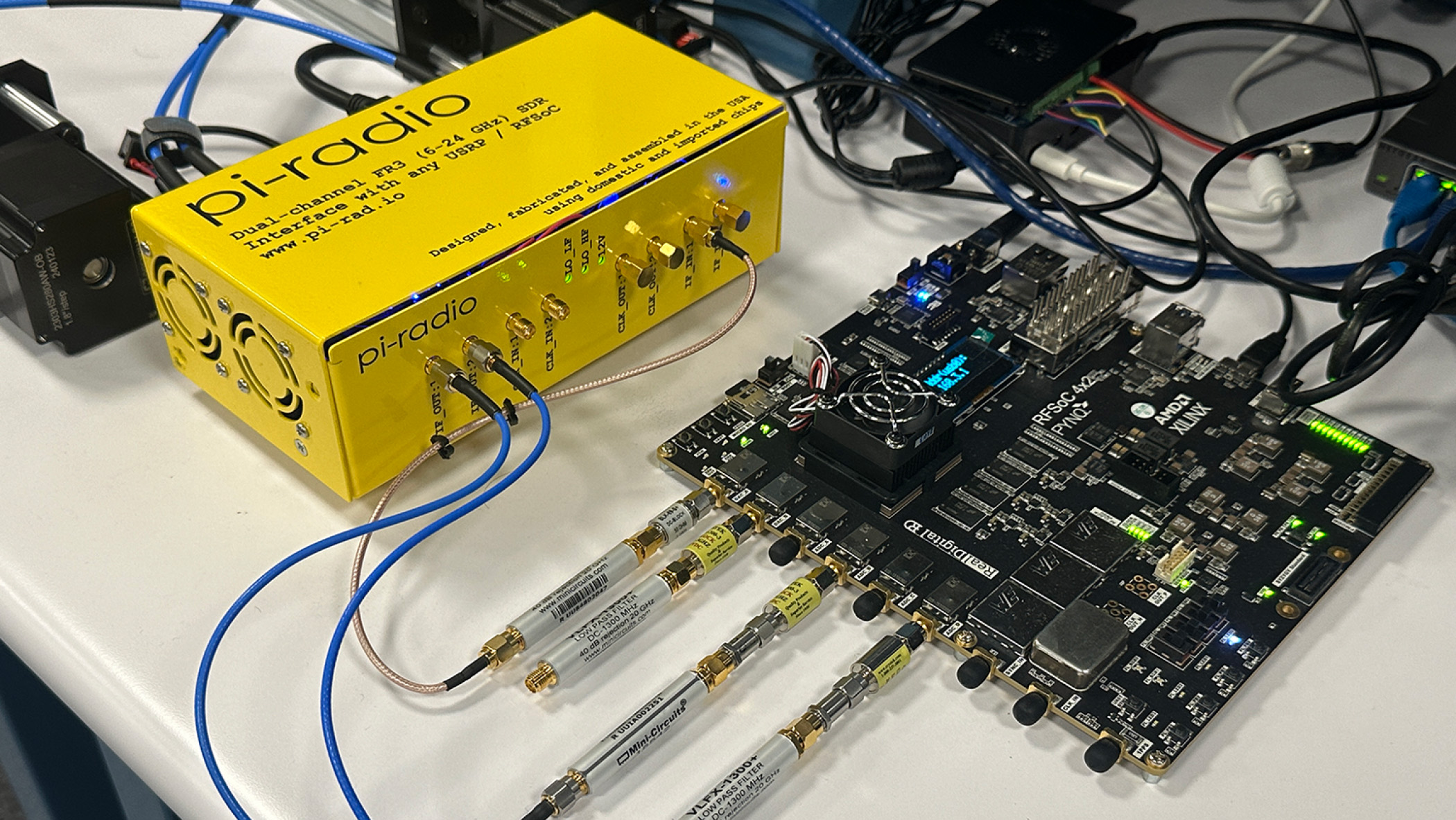
NYU Tandon will oversee a team of academic and industry partners to achieve those objectives. Pi-Radio — a startup spun out of NYU Tandon that received sponsorship from NYU WIRELESS, the Center for Advanced Technology in Telecommunications, and the NTIA — will lead development of the physical radio platform – including packaging, antennas, and system integration.
In 2023, NYU Tandon and Pi-Radio received one of the first grants awarded from the Public Wireless Supply Chain Innovation Fund. That award supported the development of an initial version of the system in the upper mid-band. The current project will build on this highly successful project to create an RFIC-based version with much lower cost and power and greater scale suitable for commercial systems.
Princeton University’s Professor Kaushik Sengupta and NYU Tandon Assistant Professor Hamed Rahmani bring considerable expertise in advanced RFICs and will lead the development of the proposed radio micro-chip itself.
Rutgers University’s WINLAB will provide critical testing facilities for the project – first at their indoor ORBIT lab in New Jersey, and later supporting outdoor trials at the COSMOS testbed in New York City. WINLAB also runs one of the largest O-RAN testing and integration centers that will be leveraged for this project.
Nokia, a global leader in wireless network infrastructure and NYU WIRELESS affiliate member, will evaluate SALSA technology for cellular networks. The evaluation results will be used for future product design requirements for commercialization.
Analog Devices, a global semiconductor leader and also an Industrial Affiliate member of NYU WIRELESS, will provide specialized radio hardware that helps connect the project’s wireless technology to O-RAN, making it compatible with equipment from different manufacturers.
Quotes:
Chuck Schumer, United States Senator: “This $9.9 million federal investment, funded by the CHIPS and Science Act I shepherded through Congress, not only supports NYU Tandon and its academic partners, but also shows the National Telecommunications and Information Administration’s commitment to developing more wireless infrastructure in New York and across the United States. I’m proud to support the federal funding needed for projects focused on developing O-RAN, advanced microchips and wireless systems for more resilient cellular wireless networks.”
Hope Knight, President, CEO and Commissioner, Empire State Development: “This federal award to NYU Tandon and its partners reaffirms New York State’s position as the epicenter of next-generation wireless innovation. The SALSA project, which brings together world-class academic institutions, startups, and industry leaders, demonstrates how New York’s complete innovation ecosystem is advancing Open RAN technology and 6G networks. From research excellence to advanced manufacturing at New York facilities, this collaboration showcases why our state continues to lead in developing the telecommunications technology of tomorrow.”
Aditya Dhananjay, Co-founder and President, Pi-Radio: “Pi-Radio (an NYU-spinoff small business) is excited to work with the amazing RF team at NYU and Princeton to develop these FR3 front-end chips, and take the critical next step of “chip to system” translation to enable real-world systems in cellular, satellites, and defense. This important commercialization work would not have been possible without support from the New York State Center for Advanced Technologies in Telecommunications (CATT), NYU WIreless, and the NTIA.”
Bryan Goldstein, Corporate Vice President, Aerospace, Defense and Communications, Analog Devices, Inc. (ADI): “Congratulations to NYU Tandon and the broader team for winning the NTIA award to continue development of new technologies for energy efficient, secure Large-Scale Array Open RAN radio units. The team’s progress during the last 18 months demonstrates the value of this effort. This award will help bring the technology to the next level, and ADI is excited to continue contributing to the project’s success.”
Hamed Rahmani, Assistant Professor, Electrical and Computer Engineering, NYU Tandon School of Engineering: “This project presents an exciting opportunity to explore the hardware challenges of radio systems in the upper mid-band. The unique properties of this frequency band offer a balance between coverage and bandwidth, which could be crucial for the next generation of cellular applications. Our focus will be on developing broadband and energy-efficient techniques to help realize this vision, with the hope that our results will contribute to the commercialization of the FR3 band.” Directing the Research in Advanced Integrated Circuits and Systems (RAISE) lab, Rahmani’s research is focused on integrated circuits and systems to enable a broad range of communication, imaging, and sensing technologies.
Kaushik Sengupta, Professor, Electrical and Computer Engineering, Princeton University: “At Princeton, we are excited to partner with NYU and the team to work on addressing the upper mid-band. We cannot take commercial chips out there, and build effective and efficient systems. It just won’t work. To realize this vision, we need carefully designed custom wireless chips, and it is critical to make them energy efficient.” Sengupta directs one of the leading research groups in the field of wireless integrated circuits and systems.
Ivan Seskar, Chief Technologist at Rutgers University/WINLAB and Program Director of the COSMOS testbed: “At WINLAB, we are excited to evaluate FR3 technology using the newly developed RFIC-based system and its integration into the O-RAN ecosystem. This collaboration not only brings novel bands to 5G/6G but also paves the way for innovative advancements in wireless technology and the development of next-generation wireless systems.”
Peter Vetter, President of Bell Labs Core Research, Nokia: “For 100 years, Bell Labs has been pioneering technological advancements, from the inception of the Bell Telephone System to the emerging 6G landscape. Nokia Bell Labs continues to drive U.S. technology leadership. We are proud to collaborate with our esteemed university partners, NYU, Princeton, and Rutgers in the SALSA project, to advance upper mid-band technologies.